Smart Building Materials (SbM) Lab
Welcome to our lab website!! 👋😊
Welcome to the Smart Building Materials (SbM) Lab at the University of Calgary, led by Dr. Barney Haoyun Miao. Founded in August 2026, our research group explores innovative approaches to creating sustainable, intelligent, and resilient materials that will shape the future of the built environment.
Why Smart Building Materials (SbM)? The word “Smart” in SbM represents more than just digital technology. It reflects our vision for the future of construction: materials that are smart by design, smart by manufacturing, and smart throughout their lifetime. We develop smart materials by creating affordable, low-carbon alternatives to conventional construction materials. We enable smart manufacturing by integrating AI and non-destructive sensing to monitor and optimize material production. Finally, we support smart infrastructure by using data-driven approaches to predict performance and improve the resilience of built systems.
By combining sustainable materials with artificial intelligence, the SbM-Lab is advancing the next generation of construction materials through the integration of nature-inspired material design, artificial intelligence, sensing technologies, and circular manufacturing strategies. Our mission is to develop affordable, high-performance, and environmentally responsible materials that enable a transition toward a decarbonized and resilient built environment.
Academic Collaborators
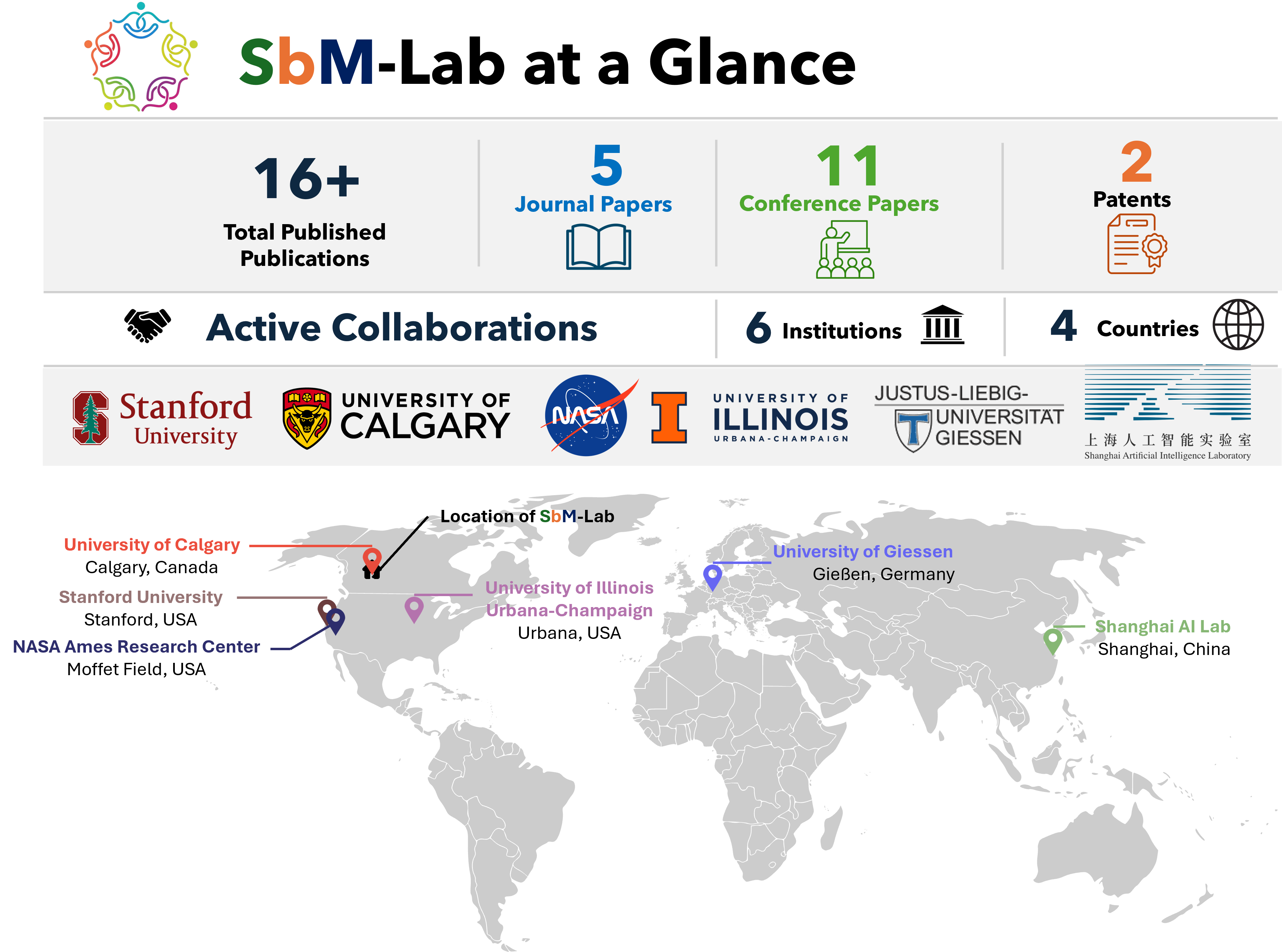
- Prof. Michael D. Lepech (Stanford University)
- Dr. David Loftus (NASA Ames Research Center)
- Prof. Yiwen Dong (University of Illinois-Urbana Champaign)
- Prof. Rahil Khosnazar (University of Calgary)
- Prof. Hae Young Noh (Stanford University)
- Prof. Andreas Theissler (Justus Liebig Univeristy Giessen)
Overview of SbM-Lab
The construction industry is responsible for a significant portion of global carbon emissions, resource consumption, and material waste. To address these challenges, our research develops Smart Circular Building Materials (SCBM)—a closed-loop framework that integrates material innovation, lifecycle assessment, intelligent monitoring, and circularity to transform how construction materials are designed, manufactured, and reused.
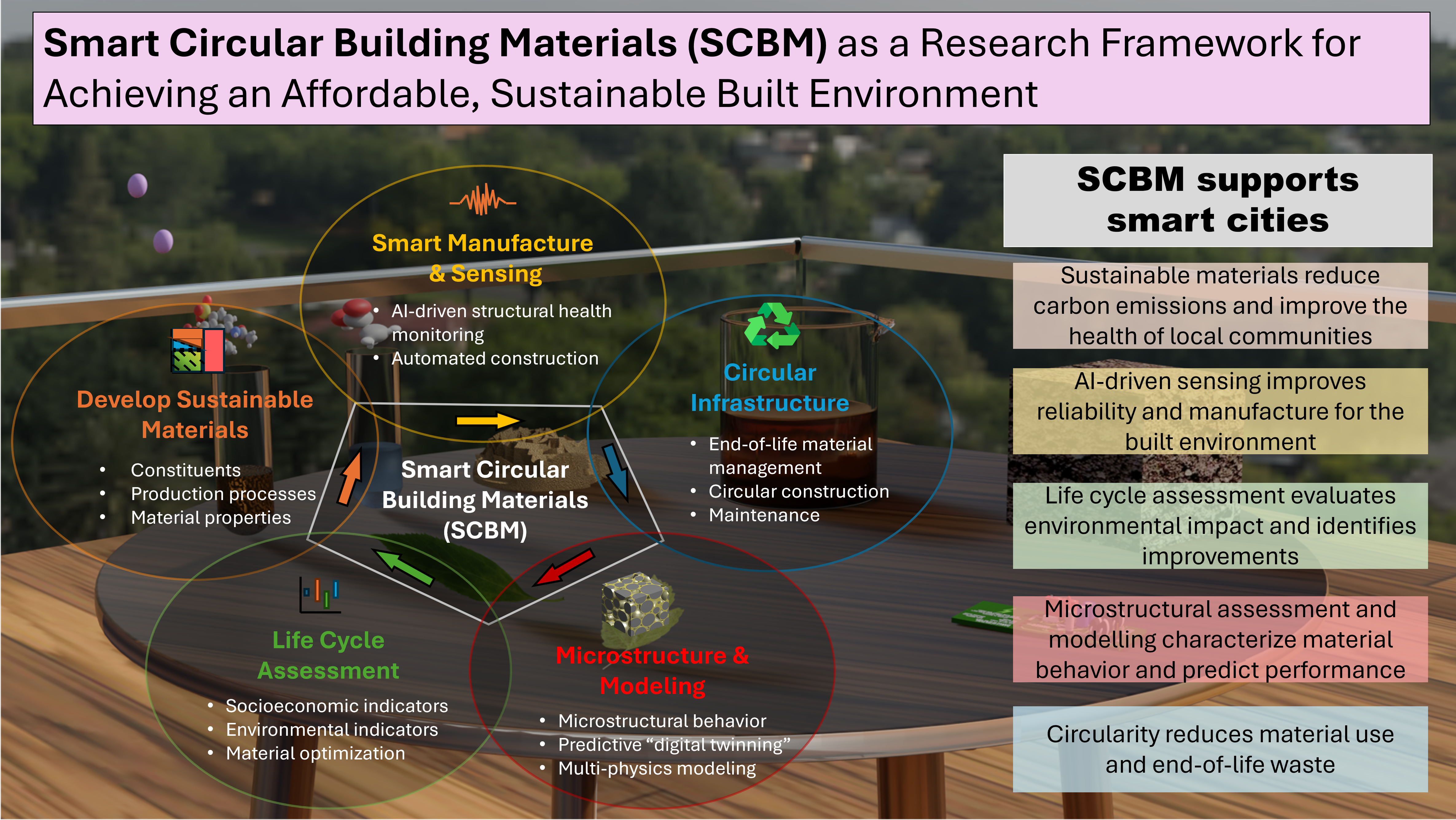
Our research focuses on five interconnected areas:
1. 🌳 Nature-Inspired Building Materials
We develop bio-based and waste-derived construction materials that replace conventional cement-based systems while maintaining structural performance. By leveraging renewable biopolymers such as lignin, we create cement-free composites with applications ranging from sustainable building components to structural infrastructure.
2. 🧮 Sustainable Manufacturing and Life-Cycle Design
We apply life-cycle assessment (LCA) and data-driven optimization to identify low-carbon manufacturing pathways, reduce environmental impacts, and guide the development of sustainable construction technologies.
3. ♻️ Circular Construction Systems
We investigate recycling, reuse, and material recovery strategies to establish closed-loop construction systems where materials can be continuously repurposed rather than discarded.
4. 🤖 AI-Enabled Sensing and Smart Manufacturing
We integrate sensors, machine learning, and artificial intelligence to create intelligent materials capable of monitoring their manufacturing processes, detecting defects, and predicting mechanical performance throughout their service life.
5. 🔬 Multiscale Characterization and Predictive Modeling
We combine advanced characterization techniques, including microscopy and micro-computed tomography, with computational modeling to uncover structure–property relationships and enable predictive design of next-generation materials.
A major research direction of the SbM-Lab is the development of Engineered Biopolymer Composite (EBC), a recyclable and low-carbon construction material that uses bio-derived polymers to bind granular materials. Through optimized processing, circular design, and intelligent monitoring, EBC demonstrates the potential to achieve mechanical performance comparable to conventional concrete while significantly reducing environmental impacts.
By bridging materials science, civil engineering, sustainability, and artificial intelligence, the SbM-Lab aims to create a future where construction materials are not only stronger and more sustainable, but also smart, circular, and adaptive components of tomorrow’s infrastructure.
If you share our vision for a sustainable future, we would love to hear from you and explore opportunities for collaboration! Also, check out available opportunities for the group (more information to follow soon)!